
The Mystery Vault
Explore Cases
Contact Us
The Dyatlov Pass incident was a mysterious event in which nine experienced Soviet hikers lost their lives under unexplained circumstances in the northern Ural Mountains of the former Soviet Union during the night of 1–2 February 1959. The expedition, organized by the Ural Polytechnical Institute and led by Igor Dyatlov, was undertaking one of the most demanding long-distance ski expeditions recognized at the time. Despite the group's experience and careful preparation, the journey ended in one of history's most enduring unsolved mysteries. After establishing camp on the eastern slope of Kholat Syakhl, a mountain whose name in the local Mansi language is often translated as "Dead Mountain," something occurred during the night that prompted the hikers to abandon their tent in extreme haste. Investigators later discovered that the tent had been cut open from the inside, indicating that the group exited by slicing through the fabric rather than using the entrance. The hikers fled into severe winter conditions wearing inadequate clothing despite temperatures estimated to have fallen to around −40 °C (−40 °F), accompanied by strong winds and heavy snowfall. The strange circumstances surrounding the campsite, the scattered locations of the victims, and the unusual injuries sustained by some members of the group have fueled decades of investigation and debate. Although modern investigations have offered new interpretations of the incident, the exact sequence of events that led to the deaths of the nine hikers remains one of the world's most famous unresolved mysteries.
The Dyatlov Pass expedition began in early 1959, when a group of students and experienced outdoor enthusiasts from the Ural Polytechnical Institute organized a skiing expedition across the remote northern Ural Mountains in Sverdlovsk Oblast, Soviet Union. According to documents later recovered from the group's tent, the expedition was reportedly dedicated to the 21st Congress of the Communist Party of the Soviet Union (CPSU) and may have been organized with the support of the local Komsomol organization. The journey was led by Igor Dyatlov, a 23-year-old radio engineering student who assembled a team of nine fellow hikers, most of whom were students or graduates of the same institute. The original expedition consisted of eight men and two women, although one participant withdrew before the main journey due to health problems, leaving nine hikers to continue. Every member of the group was an experienced Grade II ski hiker with previous winter trekking experience. Successfully completing the expedition would qualify them for Grade III certification, the highest level of hiking qualification available in the Soviet Union at the time. Achieving this certification required completing a demanding expedition of approximately 300 kilometers (190 miles) through difficult terrain and severe winter conditions.
Dyatlov carefully planned the route to pass through the remote northern regions of Sverdlovsk Oblast and the upper reaches of the Lozva River, with the ultimate objective of reaching Mount Otorten, located approximately 10 kilometers (6.2 miles) north of the location where the tragedy would later occur. The proposed route received official approval from the Sverdlovsk City Route Commission, a division of the Sverdlovsk Committee of Physical Culture and Sport, on 8 January 1959. Classified as a Category III expedition, the journey was intentionally scheduled for February, the most challenging time of year due to extreme cold, deep snow, and harsh weather conditions. On 23 January 1959, the group was issued its official route book, outlining the planned course along Trail No. 5. The expedition documentation listed eleven approved participants, including Semyon Zolotaryov, who had originally been assigned to a different expedition of comparable difficulty before joining Dyatlov's team. On the same day they received their travel authorization, the group departed from Sverdlovsk—known today as Yekaterinburg—beginning the expedition that would ultimately become one of the world's most enduring unsolved mysteries.
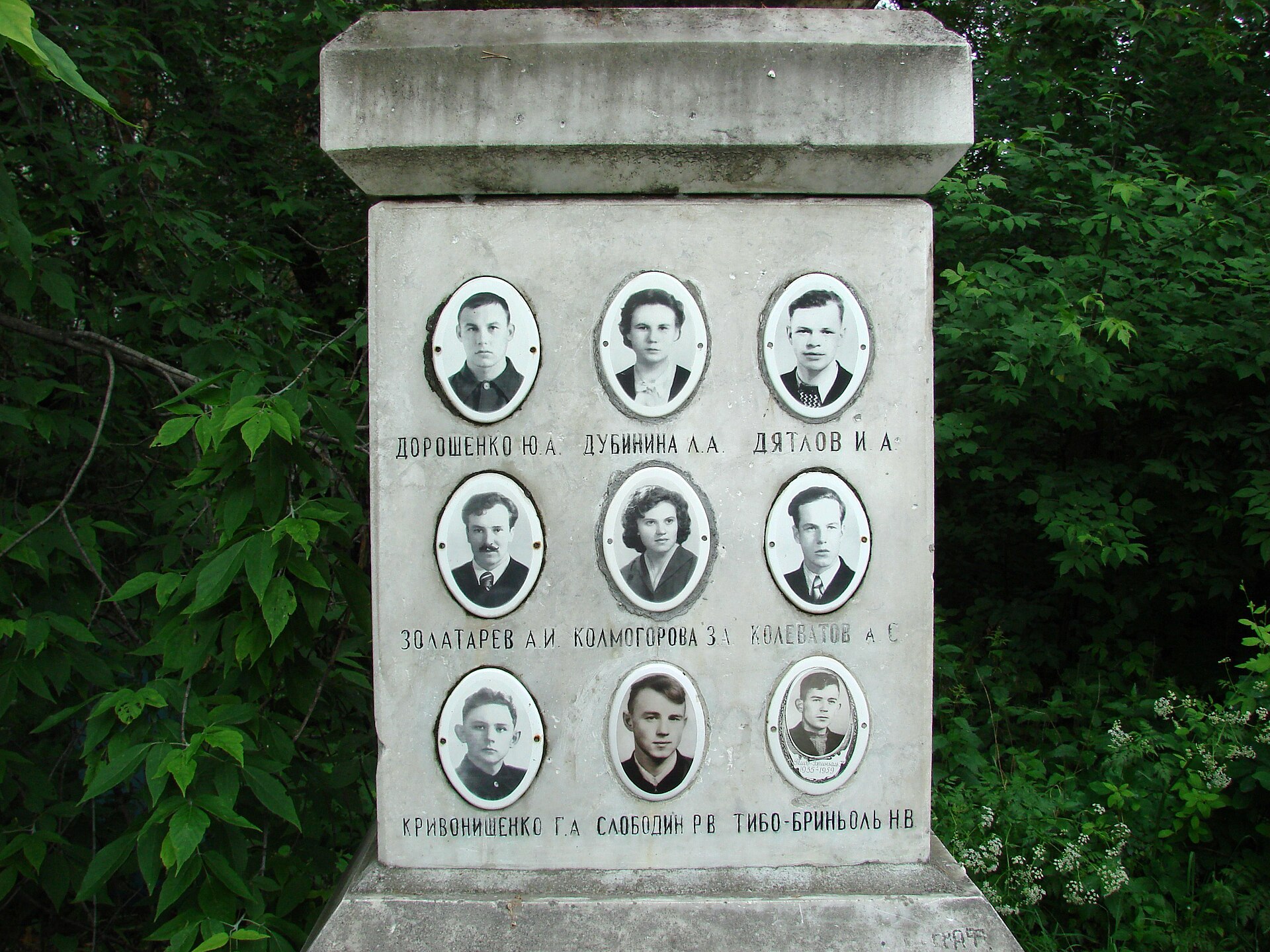
| Name | Age | Gender | Cause of Death | Location Found |
|---|---|---|---|---|
| Igor Alekseyevich Dyatlov | 23 | Male | Hypothermia (Found Deceased) | Mountain Slope |
| Yuri Nikolayevich Doroshenko | 21 | Male | Hypothermia (Found Deceased) | By a Pine tree |
| Lyudmila Alexandrovna Dubinina | 20 | Female | Internal bleeding from severe chest trauma (Found Deceased) | By a Stream |
| Georgiy Alexeyevich Krivonishenko | 23 | Male | Hypothermia (Found Deceased) | By a Pine Tree |
| Alexander Sergeyevich Kolevatov | 24 | Male | Hypothermia (Found Deceased) | Stream |
| Zinaida Alekseyevna Kolmogorova | 22 | Female | Hypothermia (Found Deceased) | Mountain Slope |
| Rustem Vladimirovich Slobodin | 23 | Male | Hypothermia (Found Deceased) | Mountain Slope |
| Nikolai Vladimirovich Thibeaux-Brignolles | 23 | Male | Fatal Skull Injury | Stream |
| Semyon Alekseyevich Zolotaryov | 38 | Male | Severe chest trauma | Stream |
Before beginning the expedition, Igor Dyatlov arranged to send a telegram to his sports club once the group had safely returned to Vizhai. The message was expected to arrive no later than 12 February 1959, although Dyatlov had previously informed Yuri Yudin, the group member who left the expedition early due to illness, that the journey might take slightly longer than planned. When no telegram arrived by the expected date, there was initially little concern, as delays of several days were not uncommon for winter expeditions in the remote Ural Mountains. However, as time passed without any contact, concern steadily grew among the hikers' relatives and colleagues. On 20 February 1959, after repeated attempts to obtain information proved unsuccessful, the families of the missing hikers urged authorities to organize a search. The Ural Polytechnical Institute responded by assembling the first rescue teams, which consisted primarily of volunteer students and teachers familiar with the region. As the seriousness of the situation became apparent, the operation expanded significantly, with military personnel and Soviet militsiya (police) joining the search. Aircraft, including planes and helicopters, were also deployed to help locate the missing expedition across the vast and snow-covered terrain.
The breakthrough came on 26 February, when searchers discovered the group's abandoned tent on the eastern slope of Kholat Syakhl. The campsite immediately raised alarm. The tent was found partially collapsed under snow and had been cut open from the inside rather than opened through its entrance. Inside, investigators discovered the hikers' personal belongings, equipment, footwear, and supplies still neatly arranged, indicating that the group had left the shelter suddenly without taking essential winter gear. Nine sets of footprints, some made by individuals wearing only socks, a single shoe, or no footwear at all, led away from the campsite toward a nearby forest approximately 1.5 kilometers (1 mile) away before eventually disappearing beneath fresh snowfall. Following the tracks into the forest, searchers reached the edge of a large Siberian pine, where they discovered the remains of a small campfire and the first two victims, Yuri Krivonischenko and Yuri Doroshenko. Both men were barefoot or inadequately clothed, wearing only their underwear despite the freezing temperatures. Broken branches extending nearly five meters (16 feet) up the tree suggested that at least one of the hikers had climbed it, possibly in an attempt to observe the campsite or search for the others. Between the cedar tree and the abandoned tent, search teams later recovered the bodies of Igor Dyatlov, Zinaida Kolmogorova, and Rustem Slobodin. Their positions appeared to indicate they had been attempting to make their way back toward the tent before succumbing to the conditions.
The remaining four members of the expedition were not discovered until 4 May 1959, more than two months after the initial search began. Their bodies were found beneath approximately four meters (13 feet) of snow inside a ravine about 75 meters (246 feet) beyond the cedar tree. Unlike the first five victims, several of these hikers were wearing additional clothing, and investigators noted evidence that garments had been removed from those who died earlier and reused by the survivors in an apparent effort to protect themselves from the extreme cold. Among the most notable examples was Lyudmila Dubinina, who was found wearing the burned and torn trousers of Yuri Krivonischenko, while her left foot and shin had been wrapped with part of a torn jacket, illustrating the desperate attempts made by the group to survive after abandoning their camp.
Following the recovery of the first five victims, Soviet authorities immediately opened a formal legal inquest to determine the circumstances surrounding the tragedy. Forensic examinations concluded that Igor Dyatlov, Zinaida Kolmogorova, Yuri Doroshenko, Yuri Krivonischenko, and Rustem Slobodin had all died primarily from hypothermia. Although Slobodin was found to have a small fracture in his skull, medical examiners determined that the injury was not severe enough to have caused his death and was therefore considered non-fatal. The investigation took a dramatic turn after the remaining four hikers were discovered in early May. Autopsies revealed that three of them had suffered catastrophic traumatic injuries. Nikolai Thibeaux-Brignolle sustained a severe skull fracture, while Lyudmila Dubinina and Semyon Zolotaryov had extensive fractures to the chest. According to forensic expert Boris Vozrozhdenny, the force required to inflict such injuries would have been comparable to that experienced in a serious automobile collision. Despite the severity of the fractures, investigators noted an unusual absence of significant external wounds, suggesting that the injuries resulted from an intense compressive force rather than direct blows from a sharp or blunt object.
Further examination of the four hikers recovered from the ravine revealed extensive damage to the soft tissues of the head and face. Dubinina was missing her tongue, both eyes, part of her lips, sections of facial tissue, and a fragment of skull bone. Zolotaryov was also found without his eyeballs, while Alexander Kolevatov's eyebrows were absent. Because the bodies had remained for several months in a snow-covered ravine containing running water, forensic specialists concluded that these injuries occurred after death as a result of natural decomposition and environmental exposure rather than violence inflicted before or at the time of death. Investigators also carefully documented the condition of the campsite and the victims. The tent had been cut open from the inside, and there was no evidence that anyone other than the nine hikers had been present in the area. Footprints leading away from the tent indicated that the group had left the campsite on foot and of their own accord. Many of the victims were found only partially dressed despite temperatures estimated between −25 °C and −30 °C (−13 °F to −22 °F) during the night of the incident. Some wore only socks, while others had a single shoe or were barefoot. The better-clothed members discovered in the ravine were wearing garments that had originally belonged to those who died earlier, indicating that clothing had been redistributed in an effort to survive the extreme cold.
The official investigation also estimated that the hikers died approximately six to eight hours after their final meal, helping investigators narrow the likely timeline of events. During the forensic examination, low levels of radiation were detected on the clothing of one victim, a finding that later attracted considerable attention. However, the released investigative documents provided little additional explanation regarding its source. The published case files also contained no detailed information concerning the condition of the victims' internal organs. Despite the unusual combination of evidence, investigators were unable to establish a definitive sequence of events explaining every aspect of the tragedy. The official findings documented the physical evidence, autopsy results, and environmental conditions surrounding the deaths, but several questions remained unanswered. These unresolved elements have continued to make the Dyatlov Pass incident one of the most extensively studied and debated cold cases in modern history.
The events surrounding the Dyatlov Pass incident occurred within a very short period of time and are best understood as a continuous narrative rather than a series of dated milestones. As a result, the complete chronology has been incorporated into the Case Details section instead of being presented separately.
Following the original investigation in 1959, Soviet authorities officially concluded that the hikers had died as the result of a "compelling natural force." No individual or organization was held responsible for the incident, and with no evidence identifying a guilty party, the legal inquest was formally closed in May of that year. The investigation files were subsequently transferred to a secret archive, where they remained inaccessible to the public for decades. Interest in the case persisted, eventually prompting Russian authorities to reopen the investigation in February 2019. The renewed inquiry focused exclusively on natural explanations, limiting its scope to three possible scenarios: an avalanche, a snow slab avalanche, or hurricane-force winds. Investigators explicitly ruled out homicide, indicating that no evidence had been found to support the involvement of another person or group.
The official conclusion has been widely criticized for its vagueness. By attributing the hikers' deaths to an unspecified "compelling natural force," investigators did not identify the exact event or mechanism responsible for the tragedy. The investigation was closed without providing a detailed reconstruction of the hikers' final hours, leaving many questions unanswered. Critics also point to the long period during which the case files remained sealed, arguing that the lack of transparency contributed to decades of speculation and alternative theories.
The infrasound hypothesis proposes that powerful winds passing over the slopes of Kholat Syakhl generated a phenomenon known as a Kármán vortex street. Under specific atmospheric conditions, this process can produce infrasound—low-frequency sound waves that are below the range of human hearing but have been suggested to influence human perception and emotional state. Popularized by Donnie Eichar in his 2013 book Dead Mountain, the theory suggests that prolonged exposure to these low-frequency sound waves may have caused the hikers to experience intense anxiety, panic, or psychological distress. In a state of fear, the group may have rapidly cut their way out of the tent and fled down the mountainside without taking the time to gather essential clothing and equipment. According to the hypothesis, the hikers eventually moved beyond the area where the infrasound was strongest, allowing them to regain their composure. However, by then they were already exposed to extreme winter conditions and, in the darkness, were unable to safely return to their campsite. Supporters of the theory further suggest that the severe injuries sustained by three members of the group occurred later, when they accidentally fell into the nearby ravine while attempting to survive.
Despite its popularity, the infrasound hypothesis remains speculative and has not been widely accepted as the definitive explanation for the incident. While low-frequency sound has been studied for its potential psychological effects, there is no conclusive scientific evidence that naturally occurring infrasound can consistently trigger the intense panic or irrational behavior required to explain the hikers' sudden evacuation. Critics also note that the theory does not fully account for all aspects of the incident, including the severe traumatic injuries sustained by three members of the group and several other unanswered questions surrounding the case.
The Military Testing Theory proposes that the Dyatlov hiking group unintentionally entered an area where the Soviet military was conducting parachute mine exercises. According to this hypothesis, the hikers were awakened by loud aerial explosions and, believing they were in immediate danger, hurriedly cut their way out of the tent and fled down the mountainside without gathering essential clothing or equipment. Supporters of the theory suggest that, after escaping the campsite, the group attempted to survive in the nearby forest. As the extreme cold took its toll, some hikers succumbed to hypothermia, prompting the survivors to remove clothing from the deceased in an effort to stay warm. The severe internal injuries suffered by several members of the group are attributed to the powerful shock waves produced by parachute mines, which are designed to detonate above the ground rather than upon impact. Such explosions are capable of causing significant internal trauma while leaving comparatively little external damage. The theory also points to reports of glowing orange objects observed in the sky around the time of the incident. Supporters suggest these lights may have been military aircraft, flares, or descending parachute mines associated with nearby weapons testing. The missing soft tissue found on some of the victims is generally attributed by proponents of the theory to post-mortem scavenging by animals. Some supporters further argue that certain autopsy findings, along with the reported condition of the tent, may indicate that aspects of the incident were not fully explained by the official investigation.
Although Soviet military testing in parts of the Ural region has been documented, no conclusive evidence has ever been found linking military exercises to the Dyatlov Pass incident. Investigators discovered no bomb fragments, blast damage, impact craters, or other physical evidence confirming that parachute mines detonated near the campsite. Additionally, the theory relies heavily on circumstantial evidence and interpretations of witness reports, making it difficult to verify. While it attempts to explain several aspects of the case, it has not been accepted as the definitive explanation by investigators or the broader scientific community.
The Paradoxical Undressing Theory suggests that several members of the Dyatlov hiking group experienced paradoxical undressing, a medically recognized phenomenon associated with severe hypothermia. As the body's core temperature drops to dangerously low levels, some individuals develop a false sensation of intense heat, causing them to remove their clothing despite the freezing conditions. This impaired judgment can significantly reduce a person's chances of survival. Supporters of the theory argue that this phenomenon may explain why some of the hikers were found partially clothed or barefoot despite the extreme cold. Since six members of the group were officially determined to have died from hypothermia, it has been suggested that paradoxical undressing may have contributed to their final actions after leaving the tent.
While paradoxical undressing is a well-documented medical response to severe hypothermia, it is generally considered a consequence of prolonged exposure to extreme cold rather than the event that initiated the hikers' ordeal. The theory may help explain why some victims were found inadequately dressed, but it does not explain why the group abruptly left the safety of their tent in the first place. Furthermore, evidence that some survivors removed additional clothing from those who had already died suggests that at least part of the group remained rational enough to recognize the need for better insulation, making paradoxical undressing an incomplete explanation for the overall incident.
Source: TMV
Author:TMV (Made using 'My Maps')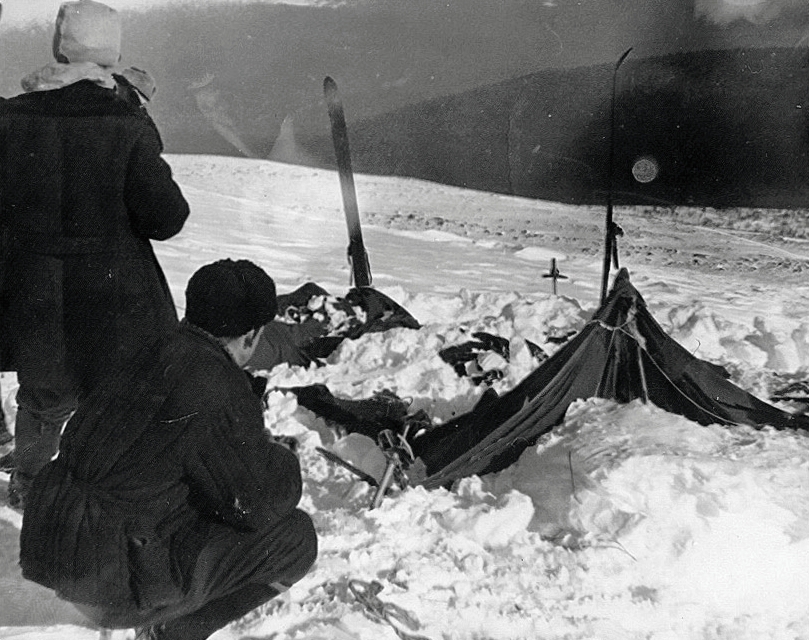
Source: Wikipedia Commons
Author: --Anonymous--
26 February 1959
Source: Wikipedia commons
Author: Dmitry Nikishin
11 June 2012